
Capacity building
One of the aims of the NAMASTE project is to build capacity in South Asia.
As a result, we currently have four NAMASTE staff members who are undertaking a PhD programme with The University of Manchester while based in South Asia.
PhD students
Madhusudan Pokharel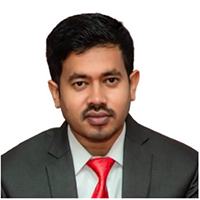
PhD student at The University of Manchester, based in Nepal.
PhD supervisors
PhD topic
My PhD focuses on implementing caregiver-mediated interventions for children with neurodevelopmental disability/autism in Nepal, assessing feasibility, acceptability, effectiveness, and scalability using the task-sharing and behaviour change wheel framework.
In my first year, I underwent extensive research training, developed a systematic review protocol and conducted an extensive literature review. In my second year, I am now currently submitting my ethics application and will begin the collection of qualitative data.
Awards and presentations
- First place in the 2024 Kohlrabi PhD thesis research summary competition.
- Presented ‘Caregiver-mediated interventions for children delivered by non-specialists: a systematic review and meta-analysis’ at the Manchester Division of Psychology and Mental Health October research seminar (16 October 2024, online).
 Abhipreet Kaur
PhD student at The University of Manchester, based in New Delhi, India.
PhD supervisors
PhD title
An exploration of the experiences of non-specialist service providers and families of children with neuro-developmental disorders participating in a community-based programme implementing a novel detection-care pathway in Delhi, India.
PhD topic
My PhD evaluates the implementation of the detection-pathway within NAMASTE in New Delhi, focusing on its acceptability, feasibility and effectiveness and generating policy and practice recommendations for advocacy of similar models, contributing to improved healthcare delivery and outcomes for children with NDDs in LMIC settings.
Ayendree Seneviratne
 PhD student at The University of Manchester, based in Colombo, Sri Lanka.
PhD supervisors
PhD topic
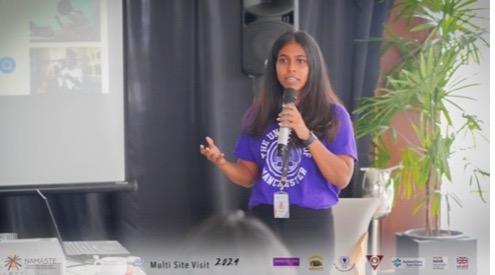 My PhD explores the how, what, where and when of play for children with autism and other developmental disorders. It includes a PROSPERO-registered systematic review on play-based interactions in South Asian cultures.
Phase two is a qualitative study capturing parent and professional perspectives on caregiver-child play, analysed using reflexive thematic analysis.
Phase 3 involves developing and piloting a culturally grounded tool to support caregiver-mediated play. I’ve completed screening and data extraction for the review, received ethics approval from The University of Manchester and Sri Lanka, and am currently obtaining local institutional permissions to begin qualitative data collection.
Divya Gosain
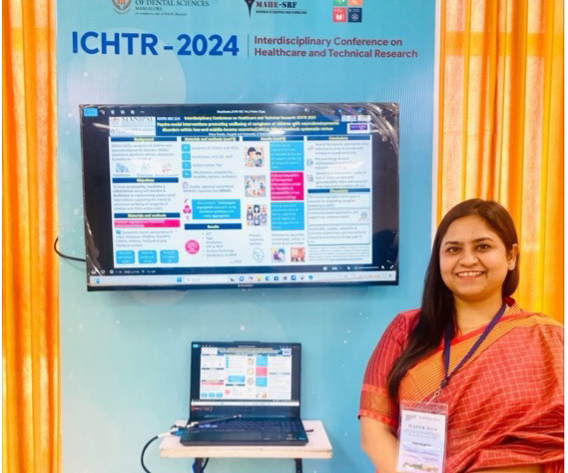 PhD student at The University of Manchester, based in New Delhi, India.
PhD supervisors
PhD topic
As part of my PhD study, I aim to develop an Acceptance and Commitment Therapy (ACT)-based intervention module to support the emotional wellbeing of caregivers of children with autism in India.
I have completed a systematic review of current psycho-social interventions available to caregivers within low-and-middle-income countries. I now plan to explore caregiver’s experiences of raising their young child with autism in India, and co-design an ACT-based intervention module to support caregiver’s mental health needs.
R Roy
 PhD student at The University of Manchester, based in New Delhi, India.
PhD supervisors
PhD title
From Policy to Practice: Strengthening implementation pathways for early detection of Neurodevelopmental Disabilities and the role of community health workers in New Delhi, India.
PhD topic
My PhD focuses on understanding how India has advanced the early detection of neurodevelopmental disabilities (NDDs) over the past several decades, and how these efforts translate into practice within real-world health systems. A key focus of my work is on the role of community health workers in extending early screening and strengthening pathways for timely identification and care, particularly in resource-constrained settings.
This research also addresses a critical gap in global evidence, where much of what we know comes from high-income countries. By centring work in low- and middle-income contexts, it aims to generate more inclusive and equitable knowledge to better inform systems serving children and adolescents with neurodevelopmental conditions.
Contact Us
+44 (0) 161 306 6000


